
Muscle Contraction Process
- vio

- Dec 14, 2019
- 4 min read
Updated: Aug 20, 2022
Properties of Muscle
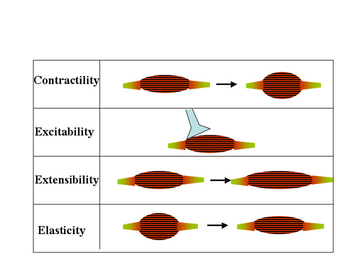
Excitability:
capacity of muscle to respond to a stimulus
For a muscle to contract and do work, its cells must be stimulated, most often by the nerves supplying them
Contractility:
ability of a muscle to shorten and generate pulling force
In the case of skeletal muscles, muscle cells contract when stimulated by neural input; smooth and cardiac muscles do not require this input
Extensibility:
muscle can be stretched back to its original length
muscles can be stretched to their normal resting length and beyond to a limited degree
Elasticity:
ability of muscle to recoil to original resting length after being stretched
Excitability
Nervous impulses cause the release of the neurotransmitter acetylcholine at the nerve-muscle junction, and the acetylcholine activates receptors on the surface of the muscle cell. This results in an influx of positively charged sodium ions into the muscle cell and a depolarization of the muscle cell membrane, which in the resting state is quite negatively charged. If the membrane becomes sufficiently depolarized, an action potential results; the muscle cell is then "excited" from an electrochemical standpoint.
When a muscle cell is excited, the impulse travels along various membranes of the cell to its interior, where it leads to the opening of calcium channels. Calcium ions flow toward and bind to a protein molecule called troponin, leading to sequential changes in shape and position of the associated proteins tropomyosin, myosin and actin
The upshot is that myosin binds to small strands within the cell called myofilaments and pulls them along, causing the cell to shorten, or contract. Since this is going on simultaneously and in a coordinated fashion in many thousands of myocytes at the same time, the muscle as a whole contracts.
Extensibility
Your muscle cells can be stretched to about three times their contracted length without rupturing. This is important because in a lot of coordinated movements, so-called antagonistic muscles operate such that one is lengthening while the other is contracting. For example, when you run, the hamstring in the back of your thigh contracts while your quadriceps are extended and conversely.
Elasticity:
When something is described as elastic, this is simply a statement that it can be stretched or contracted by some amount above or below its resting or default length without damaging it, and that it will return to this resting length once the stimulus for stretching or contraction is removed.
Your muscles require the property of elastic recoil for them to be able to do their jobs. If, say, your biceps muscles failed to recoil to their resting length after being stretched during a series of curling exercises, they would become slack, and slack muscles with no tension are unable to generate any force and are therefore useless as levers.
Types of Muscle
Skeletal
Attached to bones
Makes up 40% of body weight
Responsible for locomotion, facial expressions, posture, respiratory movements, other types of body movement
Voluntary in action; controlled by somatic motor neurons
Smooth
In the walls of hollow organs, blood vessels, eye, glands, uterus, skin
Some functions: propel urine, mix food in digestive tract, dilating/constricting pupils, regulating blood flow,
In some locations, autorhythmic
Controlled involuntarily by endocrine and autonomic nervous systems
Cardiac
Heart: major source of movement of blood
Autorhythmic
Controlled involuntarily by endocrine and autonomic nervous systems
Types of Muscle Contraction:
Static Contraction – Isometric
Does not result in any movement of the joint.
Often performed against a fixed resistance.
Isometric contractions are said to be static since a definite force is exerted with no actual movement of the muscle involved
Dynamic Contraction:
Concentric
Positive work.
The muscle produces tension and is decreasing (shortening) in length.
Example: doing a biceps curl with a dumbbell.
Eccentric
Negative work
The muscle produces tension and is increasing in length.
Example: lowering a dumbbell (elbow extension).
Muscle fibers from a motor unit are spread throughout the muscle
Not confined to one fascicle
Therefore, contraction of a single motor unit causes weak contraction of the entire muscle
Stronger and stronger contractions of a muscle require more and more motor units being stimulated
Parts of a muscle

Striated skeletal muscle tissue consists of large, cylindrical multi-nucleate muscle fibres.
The fibres are linked to form muscle body

muscle fibre is wrapped in a plasma membrane covered by a basal membrane. These two membranes together are known as the sarcolemma
Sarcoplasmic reticulum – specialized smooth endoplasmic reticulum

cytoplasm of a muscle fibre is called the sarcoplasm.
There are many different kinds of organelles in the sarcoplasm: Golgi apparatus, lipid globules, glycogen granules, abundant mitochondria and a very important structure, the sarcoplasmic reticulum.
Sarcomere
·Contractile unit of a muscle fiber

Each myofibril contains 10,000 sarcomeres end to end
Interaction between thick and thin filaments cause contraction
Banded appearance

Organization of the sarcomere
Thick filaments = myosin filaments
Composed of the protein myosin
Has ATPase enzymes

Thin filaments = actin filaments
Composed of the protein actin

Actin (Thin) Myofilaments
Thin Filament: composed of 3 major proteins
F (fibrous) actin
Tropomyosin
Troponin
Two strands of fibrous (F) actin form a double helix extending the length of the myofilament; attached at either end at sarcomere.
Composed of G actin monomers each of which has a myosin-binding site (see yellow dot)
Actin site can bind myosin during muscle contraction.
Tropomyosin: an elongated protein winds along the groove of the F actin double helix.
Troponin is composed of three subunits:
Tn-A : binds to actin
Tn-T :binds to tropomyosin,
Tn-C :binds to calcium ions.
Myosin filaments have heads (extensions, or cross bridges)
Myosin and actin overlap somewhat

Many elongated myosin molecules shaped like golf clubs.
Single filament contains roughly 300 myosin molecules
Molecule consists of two heavy myosin molecules wound together to form a rod portion lying parallel to the myosin myofilament and two heads that extend laterally.

Myosin heads:
Can bind to active sites on the actin molecules to form cross-bridges. (Actin binding site)
Attached to the rod portion by a hinge region that can bend and straighten during contraction.
Have ATPase activity: activity that breaks down adenosine triphosphate (ATP), releasing energy. Part of the energy is used to bend the hinge region of the myosin molecule during contraction

Muscle Contraction Summary
Nerve impulse reaches myoneural junction
Acetylcholine is released from motor neuron
ACh binds with receptors in the muscle membrane to allow sodium to enter
Sodium influx will generate an action potential in the sarcolemma
Action potential travels down T tubule
Sarcoplamic reticulum releases calcium
Calcium binds with troponin to move the troponin, tropomyosin complex
Myosin head attach to binding sites and create a power stroke
ATP detaches myosin heads and energizes them for another contaction
When action potentials cease the muscle stop contracting
Binding sites in the actin filament are exposed

Comments